
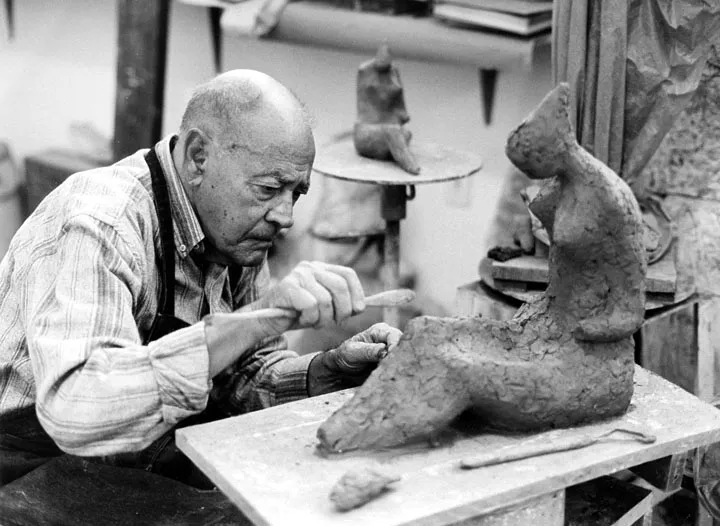
Vasco Prado
Vasco Prado (Uruguaiana, April 16, 1914 — Porto Alegre, December 9, 1998) was a renowned Brazilian sculptor, engraver, and draftsman, recognized as one of the most important and influential artists in Rio Grande do Sul. Born to a military father, he lived in various regions of Brazil before returning to Rio Grande do Sul, where he graduated from the Colégio Militar de Porto Alegre in 1936. His artistic trajectory was marked by strong political and social engagement, leading him to run for state deputy with the Brazilian Communist Party in 1946, albeit unsuccessfully.
Prado was married three times and had children with his last two wives, Zoravia Bettiol and Susana Cazarré. His artistic career had a significant impact on Gaúcho art, especially after founding the Clube da Gravura in the 1950s alongside artists like Carlos Scliar and Danúbio Gonçalves. This group was known for its socially driven works, focusing on the regionalist theme of the Gaúcho and his life in the countryside.
Throughout his career, Prado taught sculpture and drawing at various institutions, including the Atelier Livre of Porto Alegre's City Hall, the University of Caxias do Sul, and the Rio Grande do Sul Museum of Art (MARGS). His work evolved from a descriptive and socially engaged style to a more synthetic and abstract approach, while maintaining a formal balance that reflected his classical training. Despite this stylistic evolution, he never abandoned his political convictions, as evidenced by his public works addressing significant figures and themes from Brazilian history, such as Tiradentes and the Negrinho do Pastoreio.
Prado was also a master engraver, ceramist, and draftsman, with works displayed both in Brazil and abroad. One of his most well-known pieces is the "Pomona" sculpture, created in the 1950s at the Balneário Osvaldo Cruz park in Iraí, RS, for which he used a young indigenous woman from the Kaingang tribe as his model.
His influence on Brazilian art, especially in the southern region, is undeniable, having shaped generations of new artists and significantly contributing to regional and national artistic traditions.
Sources:
Text: Blombô research and curation, with the support of artificial intelligence for content writing and structuring.
Check the selection of works of this artist

