
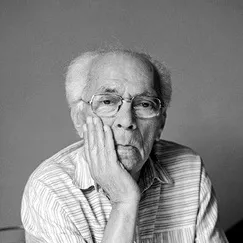
Joaquim Tenreiro
Joaquim Albuquerque Tenreiro, son and grandson of carpenters, moved to Brazil with his family at the age of two, settling in Niterói, Rio de Janeiro. In 1914, he returned to Portugal, where he helped his father with woodworking and began painting lessons. He returned to Brazil between 1925 and 1927. In 1928, he permanently moved to Rio de Janeiro, attending the drawing course at the Liceu Literário Português and taking courses at the Liceu de Artes e Ofícios.
In 1931, he joined the Núcleo Bernardelli, a group created in opposition to the academic teachings of the Escola Nacional de Belas Artes (Enba). In the 1940s, he dedicated himself to painting portraits, landscapes, and still lifes. Between 1933 and 1943, he worked as a furniture designer at the companies Laubissh & Hirth, Leandro Martins, and Francisco Gomes. In 1942, he created his first modern piece of furniture for Francisco Inácio Peixoto's residence.
In 1943, he opened his first workshop, Langenbach & Tenreiro, and a few years later, he inaugurated two furniture stores, first in Rio de Janeiro and later in São Paulo. At the end of the 1960s, Joaquim Tenreiro ceased his activities in furniture design and manufacturing to dedicate himself exclusively to the visual arts, primarily sculpture, for the next 20 years. In 1969, he created a panel for the Templo Sidon Synagogue and, in 1974, two panels for the Senai auditorium, both in Tijuca.
Sources:
Text: Blombô research and curation, with the support of artificial intelligence for content writing and structuring.
Check the selection of works of this artist

