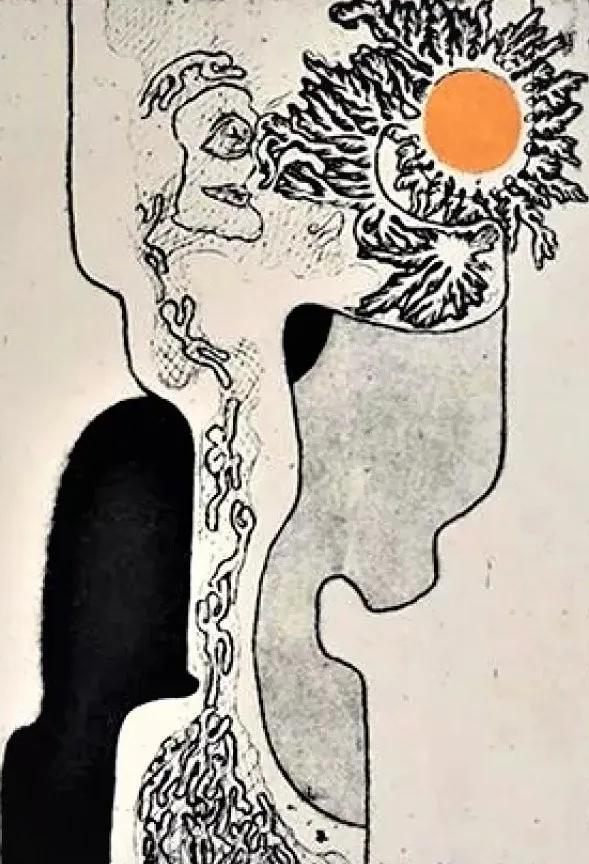

Maria Martins
Maria de Lourdes Alves Martins (Campanha, MG, August 7, 1894 — Rio de Janeiro, RJ, March 28, 1973), known artistically as Maria Martins, was a Brazilian sculptor, draughtswoman, printmaker, painter, writer, and musician. Considered one of Brazil's most influential surrealists, Maria Martins is often referred to as the "Brazilian Frida Kahlo."
Life and Work
Maria Martins was born in Campanha, Minas Gerais, the daughter of Cosmo, a senator and Minister of Justice of the Old Republic, and Fernandina de Faria Alves. Her paternal grandparents were João Luís Alves and Bárbara Luísa Barbosa Alves, and her maternal grandparents were Fernando Antônio de Faria and Maria Vitória Pereira de Faria. Her birth was declared by her father, with Dr. Euclides da Cunha and Otávio Barbosa Carneiro as witnesses.
She first married jurist and historian Otávio Tarquínio de Sousa, from whom she separated, and later married diplomat Carlos Martins Pereira e Sousa. Carlos, a childhood friend of Getúlio Vargas and a lover of social life, served as Brazil's ambassador to several countries before and after World War II, including Japan and various European nations.
Initially interested in music, Maria Martins later studied painting in Paris. At the age of thirty, she became interested in sculpture, working with wood in France and learning to model terracotta, marble, and lost wax in Japan. In 1939, she studied sculpture with Oscar Jesper in Brussels and began using bronze as the primary material for her work.
Maria Martins participated in the São Paulo Biennial from its first event in 1951. In 1955, she was awarded as the best national sculptor with the work "A soma dos nossos dias." Internationally, she held her first exhibition in 1941 in Washington and, in the same year, exhibited in Paris and Rio de Janeiro. She established her studio in New York and was featured at the Corcoran Gallery of Art in Washington, where one of her works was acquired by the Museum of Modern Art in New York (MoMA).
Her sculptures, characterized by organic, twisted, and sensual forms, evoke archaic cultures and are inspired by legends and the Amazonian nature. This approach attracted the attention of surrealists like André Breton, Max Ernst, Roberto Matta, Yves Tanguy, and Marc Chagall. Marcel Duchamp dedicated two works to her, testifying to the impact of Maria Martins' vibrant beauty and sensitivity.
Maria Martins' works were recognized internationally, with pieces in the Philadelphia Museum of Art, MoMA, Museum of Modern Art of Rio de Janeiro (MAM), Museum of Modern Art of São Paulo (MAM), and Paço das Artes of USP, among others. In the Itamaraty Palace in Brasília, there are two of her sculptures: "A mulher e sua sombra" and "O canto da noite." At the Museo de Arte Latinoamericano de Buenos Aires (MALBA), her sculpture "O Impossível" (1945) is displayed.
In addition to her artistic career, Maria Martins had a remarkable personal life. She was the lover of French-American painter and sculptor Marcel Duchamp and Benito Mussolini, as well as a friend of Picasso and Mondrian. She interviewed Mao Zedong and achieved notable feats for a woman of her time.
Sources:
Text: Blombô research and curation, with the support of artificial intelligence for content writing and structuring.
Check the selection of works of this artist