Manoel Graciano
Brazil - 1926 - 2014
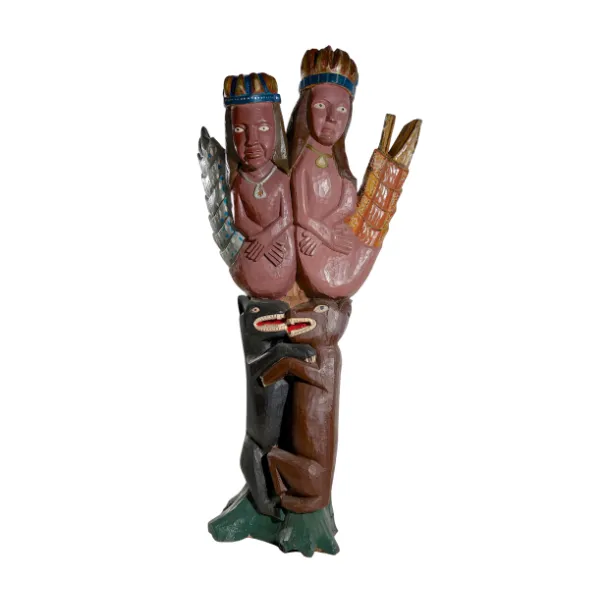
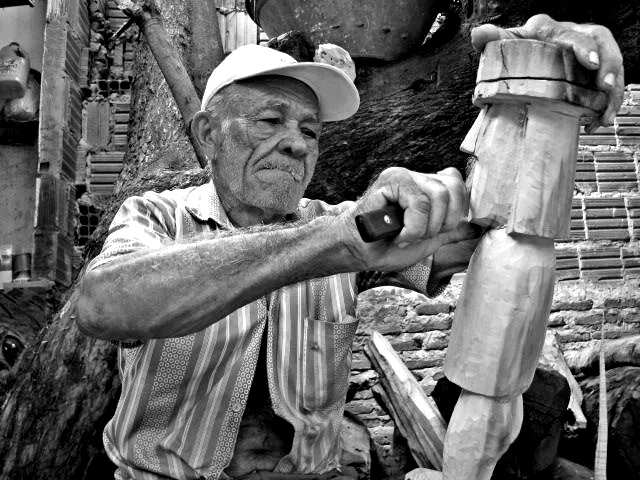
Manoel Graciano (Santana do Cariri, Ceará, 1926 - 2014) was a renowned Brazilian sculptor known for his woodworks reflecting Northeastern popular culture. In 1929, he moved with his family to Juazeiro do Norte, in the same state. He began working with wood at the age of 10, learning on his own to make pestles, bowls, and toys, inspired by the nature around him.
Married and a father of three, Manoel Graciano began producing nativity scenes and ex-votos, traditional in Brazilian popular culture. It was the woodcut artist and cordel writer Abraão Batista who encouraged him to leave the fields and dedicate himself to sculpture. Graciano developed a unique style, composing groups of characters that form true sculptural ensembles. His work is marked by a peculiar humor that, in some pieces, evolves into expressive and vibrant expressionism.
To prepare his paints, Manoel used a mixture of aniline, resin, and alcohol, applying them to woods such as imburana de cambão or aroeira. In his monoblock compositions, he preferred animal forms over human figures, using varied brushstrokes to ensure refined tonal harmony.
His artistic legacy was continued by his son Francisco Cardoso (1966) and his grandson Francisco Edinaldo. Manoel Graciano participated in the "Redescobrimento" exhibition (Fundação Bienal de São Paulo, 2000), and his works are part of the collections at the Edilson Carneiro Folklore Museum in Rio de Janeiro and the Popular Art Exhibition at the São Francisco Cultural Center in João Pessoa, Paraíba. His journey was documented in the “Pequeno Dicionário da Arte do Povo Brasileiro, Séc. XX” by Lélia Coelho Frota. Manoel Graciano passed away in 2014, leaving a significant legacy in Brazilian popular art.
Sources:
Photo: http://www.galeriaestacao.com.br/artista/31
Text: Blombô research and curation, with the support of artificial intelligence for content writing and structuring.
Check the selection of works of this artist