
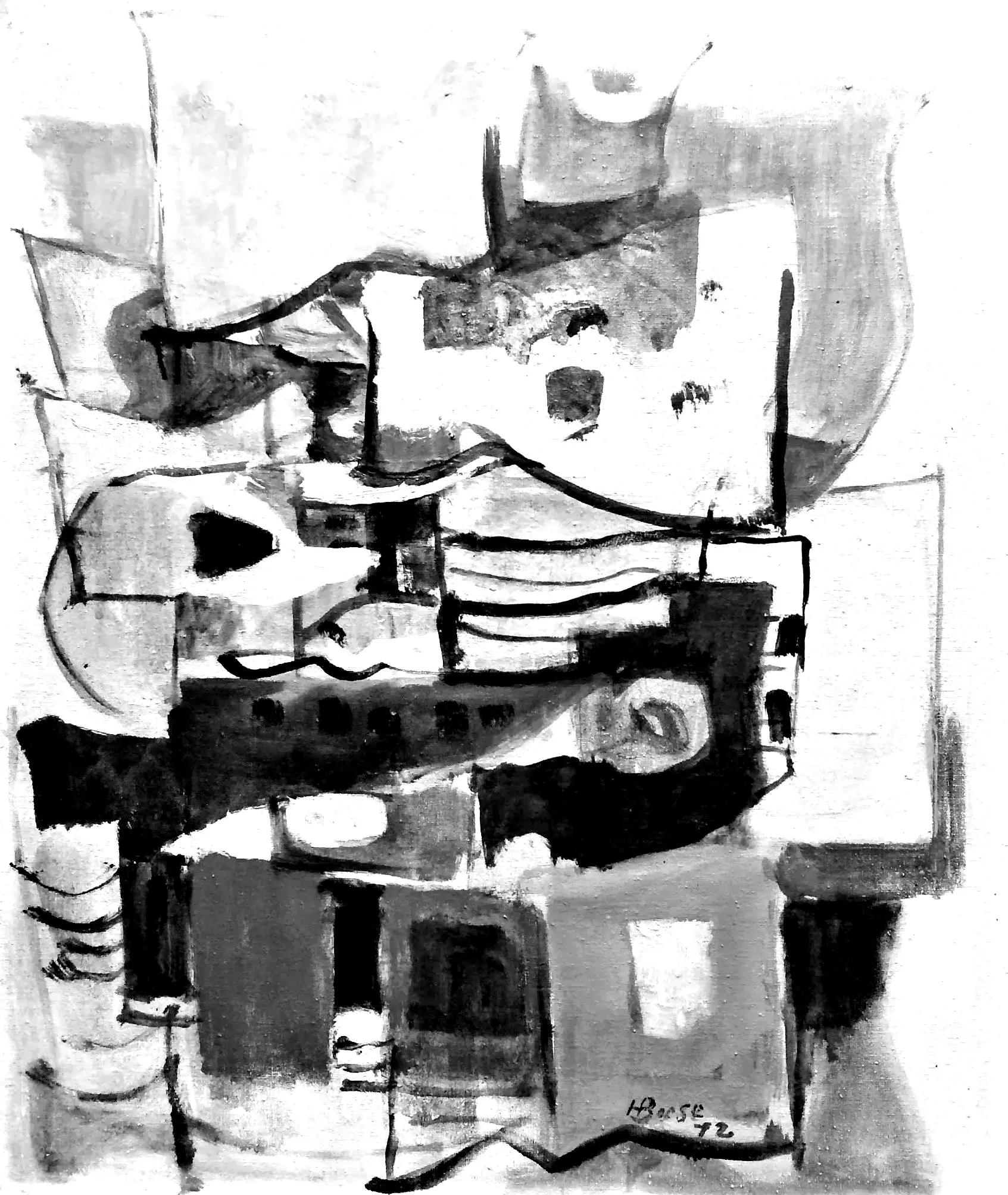
Henrique Boese
Henrique Boese, born in Berlin, Germany, in 1897 and deceased in São Paulo, Brazil, in 1982, was an influential painter and teacher. He began his artistic training at the Berlin Academy of Fine Arts in 1919, where he was a student of renowned expressionist painter and graphic artist Käthe Kollwitz. Due to the consequences of World War II, Boese moved to Brazil in 1939, initially settling in Rio de Janeiro.
In Brazil, Boese became close to artist circles linked to painter Axl Leskoschek and began teaching drawing and painting, with notable students such as Almir Mavignier. His first solo exhibition was held at the Institute of Architects of Brazil in 1947. After a trip to Europe in 1951, Boese would reside in small towns in São Paulo state before definitively settling in São Paulo in 1955.
His work, transitioning between expressionism and abstraction, is known for its depiction of distorted forms with a dramatic character, evolving into abstraction with remnants of the figurative in the 1950s. In 1972, the São Paulo Museum of Modern Art (MAM/SP) held the exhibition "Henrique Boese: 30 Years of Painting in Brazil." Posthumously, two important retrospectives of his work were presented, at the Lasar Segall Museum in 1986 and at the São Paulo Gallery in 1988.
Boese explored dense textures and transparencies in his paintings, using a contrasting color palette to create unexpected harmonies. His work, often related to music, reveals a balance between lyricism and rigor, according to critic Olívio Tavares de Araújo. Despite his significant contribution, Boese remained relatively on the fringes of the prevailing trends in the Brazilian art scene, remaining independent from specific artistic groups.
Sources:
Text: Blombô research and curation, with the support of artificial intelligence for content writing and structuring.
Check the selection of works of this artist

