
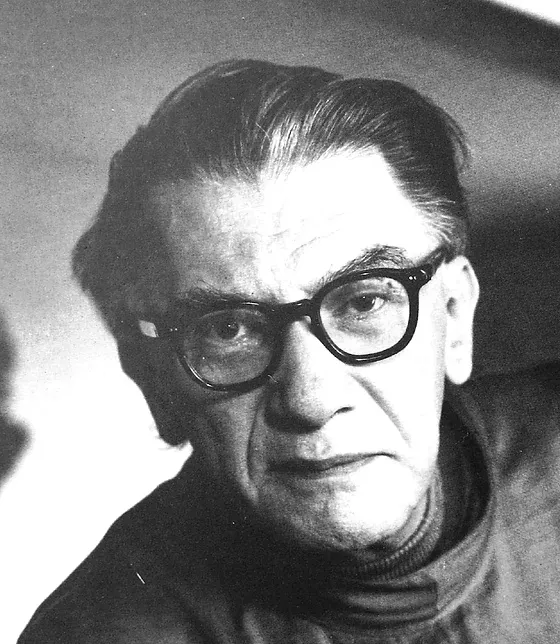
Samson Flexor
Russia - 1907 - 1971
Samson Flexor (Soroca, Bessarabia, Russia, 1907 - São Paulo, Brazil, 1971) was a painter, draftsman, muralist, and teacher. In 1922, he moved to Belgium to study chemistry and enrolled in painting courses at the Académie Royale des Beaux-Arts. Two years later, he moved to Paris to attend the free course at the École Nationale Supérieure des Beaux-Arts, guided by Lucien Simon. Simultaneously, he studied art history at the Sorbonne.
In 1926, Flexor attended La Grande Chaumière and Ranson academies, receiving lessons from Roger Bissière. The following year, he held his first solo exhibition at the Campagne Première Gallery in Paris. In 1929, he co-founded the Salon des Surindépendants, serving as director until 1938. Converted to Catholicism in 1933, Flexor began creating religious murals.
During World War II, Flexor was a member of the French Resistance and was forced to flee Paris. During this time, his paintings became darker, exploring expressionist and cubist themes of the Passion of Christ. In 1946, he visited Brazil and exhibited at the Prestes Maia Gallery in São Paulo, settling in the city in 1948.
Encouraged by critic Léon Dégand, then director of the Museum of Modern Art of São Paulo (MAM/SP), Flexor embraced geometric abstraction and founded the Atelier-Abstração in 1951. There, he taught artists such as Jacques Douchez, Norberto Nicola, Leopoldo Raimo, Alberto Teixeira, and Wega Nery. In the 1960s, his works evolved towards lyrical abstraction and a renewed approach to figuration.
Sources:
Text: Blombô research and curation, with the support of artificial intelligence for content writing and structuring.
Check the selection of works of this artist
Soon, products will be available in the selection!
