
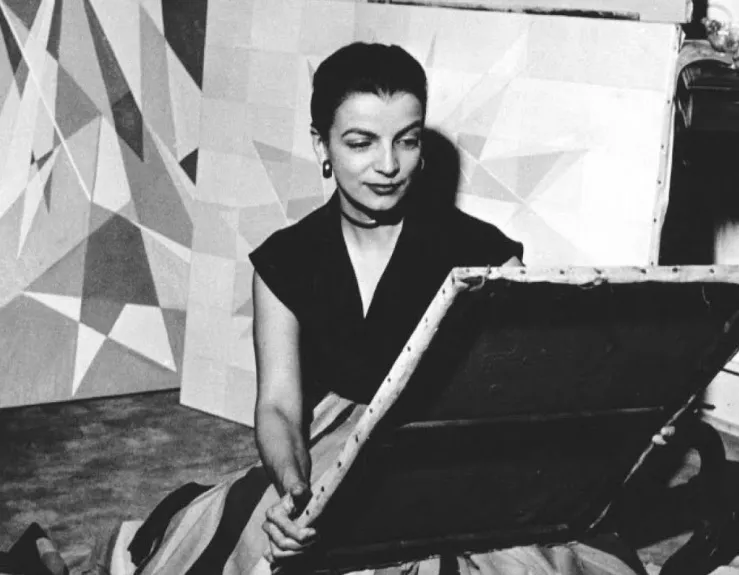
Lygia Clark
Painter and Sculptor.
Lygia Clark was a Brazilian artist born in Belo Horizonte in 1920, who emerged as one of the most innovative figures in contemporary Brazilian art. She moved to Rio de Janeiro in 1947, where she began her artistic training with landscape artist Burle Marx. Between 1950 and 1952, she lived in Paris, studying with renowned artists such as Fernand Léger, Arpad Szenes, and Isaac Dobrinsky.
Upon her return to Brazil, she joined the Grupo Frente, led by Ivan Serpa, and was one of the founders of the Neo-Concrete Movement, participating in its first exhibition in 1959. During this period, she transitioned from painting to three-dimensional objects, gaining recognition for her participatory propositions, such as the Bichos series (1960), consisting of geometric metal constructions articulated by hinges, requiring the viewer's co-participation.
Clark also dedicated herself to sensory exploration with works like A Casa É o Corpo (1968), inviting participants to a sensory immersion. She took part in important exhibitions, such as Opinião 66 and Nova Objetividade Brasileira, both at the Museum of Modern Art of Rio de Janeiro (MAM/RJ).
From 1970 to 1976, she lived in Paris, where she taught at the Faculté d’Arts Plastiques St. Charles at the Sorbonne. During this period, she moved away from producing aesthetic objects and focused on bodily and relational experiences. Returning to Brazil in 1976, Lygia Clark dedicated herself to exploring the therapeutic possibilities of sensory art and relational objects, aligning her work closer to psychoanalysis.
In the 1980s, her work gained international recognition, with retrospectives in several capitals and in anthological exhibitions of post-war international art.
Sources:
Text: Blombô research and curation, with the support of artificial intelligence for content writing and structuring.
Check the selection of works of this artist
Soon, products will be available in the selection!
