
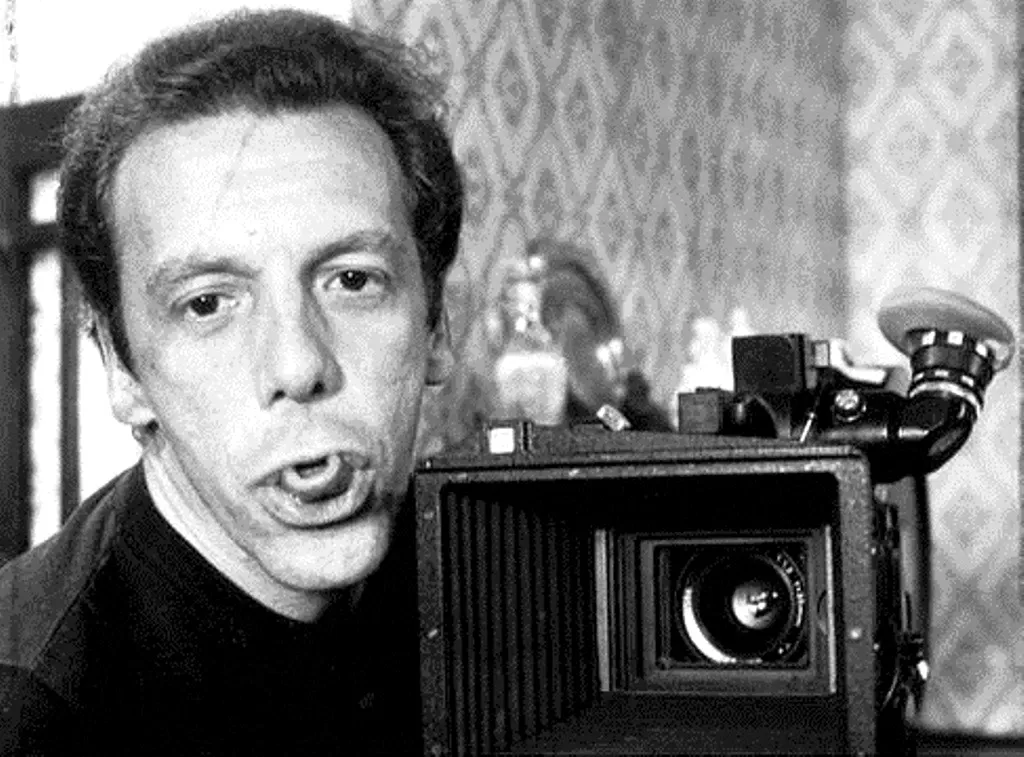
Hélio Oiticica
Hélio Oiticica (1937-1980) was an influential Brazilian performance artist, painter, and sculptor, born in Rio de Janeiro. His artistic training began in 1954 at the Museum of Modern Art in Rio de Janeiro (MAM/RJ), where he studied painting and drawing with Ivan Serpa, alongside his brother César Oiticica. Early on, Oiticica developed the habit of recording reflections on art, which became a constant practice in his career.
In 1955 and 1956, he was a member of the Grupo Frente, and in 1959, he became part of the Neoconcrete Group, a period during which he abandoned two-dimensional painting to create three-dimensional works such as spatial reliefs, bólides, capes, standards, tents, and penetrables. In 1964, Oiticica innovated with his Environmental Manifestations, including the famous work Tropicália, presented at the New Brazilian Objectivity exhibition. His art gained international prominence with the Whitechapel Experience in London in 1969, where he presented the Eden project.
Oiticica lived in New York for most of the 1970s, where he was a Guggenheim Fellow and participated in the Information exhibition at the Museum of Modern Art (MoMA). He returned to Brazil in 1978. After his death, the Hélio Oiticica Project was created in 1981 to preserve, analyze, and disseminate his work, directed by Lygia Pape, Luciano Figueiredo, and Waly Salomão. Between 1992 and 1997, a major retrospective of his work was presented in several cities around the world. In 1996, the Hélio Oiticica Art Center was inaugurated in Rio de Janeiro to house his vast collection. Unfortunately, part of this collection was destroyed in a fire in 2009.
Sources:
Text: Blombô research and curation, with the support of artificial intelligence for content writing and structuring.
Check the selection of works of this artist
Soon, products will be available in the selection!
